
After Assassin’s Creed: Syndicate, you might not be expecting Assassin’s Creed Chronicles: India so soon. This is the second installment of the three-part Assassin’s Creed Chronicles title, the first one being Assassin’s Creed Chronicles: China. This is not like your average Assassin’s Creed game wherein you are able to roam around in a seemingly open world. In India, this is a stylized 2D platformer that has been made with 3D elements. While the playstyle and visual appeal did change, it stays surprisingly true to the main series.
The Assassin’s Creed Chronicles: India is a Streamlined Take on the Popular Gaming Franchise
In Assassin’s Creed Chronicles: India, you take on the role of Arbaaz, which is the main protagonist of this installment. He is an assassin in an 1840’s Amristrar setting to which he will battle Templars and the East India Company.
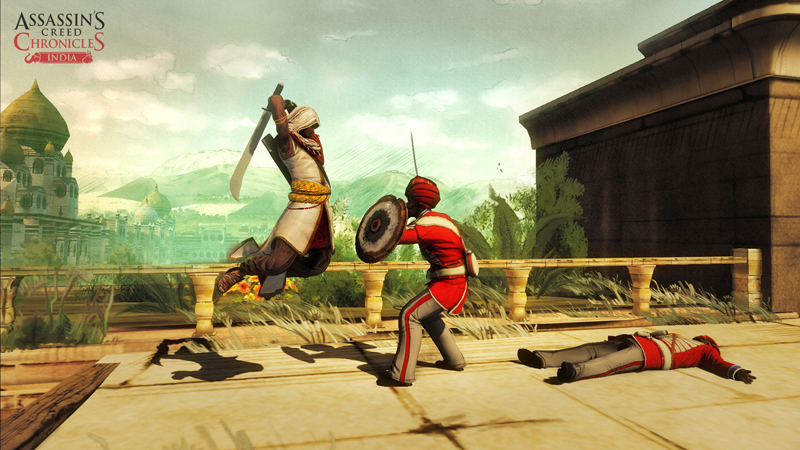
Within the game, your aim is to rescue your mentor as well as recover the Koh-i-Noor diamond. The game switches from the normal 3D open-world setting and changes it to a 2D platformer. But do not let this abrupt switch fool you into thinking this is nothing less than a visually appealing game. With its 3D elements, it still provides a great amount of eye-candy, and many of them do are reminiscent of historical India.
For gameplay, Assassin’s Creed Chronicles: India (Xbox One, PS4, PC) has a playstyle that is similar to that of Assassin’s Creed Chronicles: China. However, Arbaaz isn’t as swift or as graceful as China’s protagonist, Shao Jun. Still, the basic movement set is still there as you would help him run, jump, slid, and lurk in the shadows to get to your ultimate goals.
Arbaaz does have some new things up his sleeve, particularly in the line of new weaponry and gadgets. Complementing his ever-faithful sword are noise-maker darts, smoke bombs, and chakrams. When using the chakram, it is a thrown weapon that can ricochet off walls and kill enemies provided that you throw them at the right angle. They can also slash through ropes so that chasing enemies won’t be able to follow you.
Underneath what’s on the surface of the game, there is a subtle change of focus. While China’s Shao Jun was quick to strike and is all-around deadly fighter, Arbaaz is more attuned with the shadows. Simply put, India’s assassin is stealthier, but being spotted almost instantly leads to certain death. Players would then have to keep a close eye on the environment, wait for the right moment, and understand soldiers’ guarding patterns.
However, Assassin’s Creed Chronicles: India is marred by a frustrating control system wherein you might find yourself getting caught for a lot of times when you don’t intentionally want to in the first place. Therefore, while this game has the visual and playstyle appeal, you might end up just throwing the game controller instead because of the control system.