
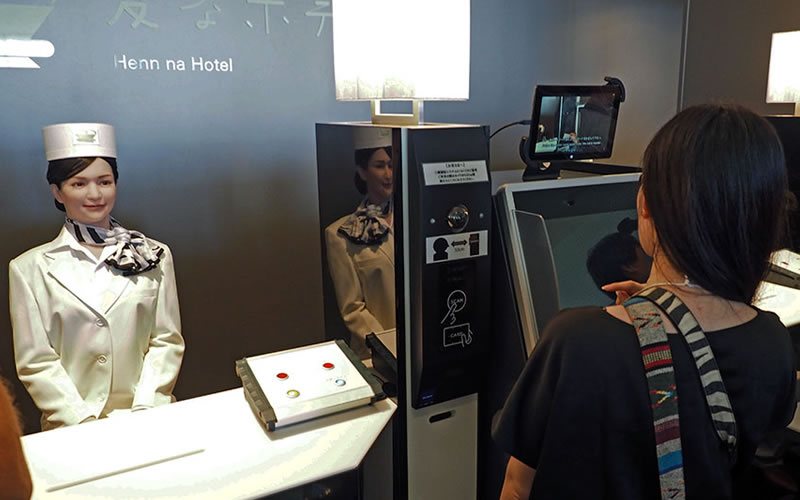
“My name is Yoshiyuki Kawazoe. This is my hotel.” The University of Tokyo’s connect professor of design gestures behind himself to a flat, two-story building it doesn’t truly look like a hotel. “Two-hundred everyone was involved in making this occur,” he claims. ” professionals in environmental style, engineering, architecture, robotics and renovation … it’s their hotel.” The “Hen-na Hotel” will go down in tourist guides as the robot hotel, but there’s much more being invested in below than just talking robotics: The minds behind it hope the home will alter the world of affordable resorts — and conserve the world. (Well, at least just a little.)
The goal of the hotel, as CEO Hideo Sawada places it, is a critical one: become one of the most reliable hotel on the world. He draws on comparisons with low-cost airline companies that ” altered exactly how we travel.” 2 yrs earlier, as hotel costs remained to increase, the CEO ( which runs the neighboring Huis Ten Bosch theme park) started conversations with robotics and design specialists with all the purpose of developing a simple yet effective hotel, one that expenses (both fiscally and ecologically) much less.
If you believed Hen-na Hotel was a kitschy gimmick, well, that is partly real. (The assistant is an English-speaking dinosaur and there’s a talking tulip in each room.) Nevertheless, the larger photo let me reveal that researchers from Japan’s biggest, many influential college are involving on their own and testing out cutting-edge green technology, as well as trying to produce an area where both robots and human beings can move around and do whatever they desire (or need) to do. Robots may help reduce staffing costs, as well as assistance to operate a hotel better. (To some extent — human employees continue to be needed — simply less of them). The complete premise might shout wacky Japan, but it’s likewise testing the boundaries of robot-human interaction on the field — and trying to earn profits as it does.
The Hen-na Hotel is Hotel Zero, a proof of idea: exactly what decreases right here will notify the following stage. Sawada-san is likely to present the Hen-na Hotel concept to two more hotels: another someplace in Japan, and another overseas, although he wouldn’t be attracted to exactly where. ” provided the viewpoint behind the hotel, the place of the site will have a large influence on what the hotel can look like, just how it’ll be developed.” The CEO didn’t mark down the theory that a hotel could be made inside a city center, while Kawazoe added that layout factors to consider will make future hotels significantly different from this real-world proof of concept. Rents are at a premium in built-up locations.
The layout of this four-building complex is arranged in a way to let air flow through the whole thing. That is crucial, because there is no a/c. Dealbreaker? Considering the fact that the hotel gets on Kyushu, the hot, moist primary southern isle of Japan, that sounds crazy. Nevertheless, while exterior temperatures reached 93 degrees Fahrenheit, the area was reassuringly awesome. That’s done through a network of high-end radiator panels, combined with heat-absorbing bricks, unique reflective paint and solar powers on the top, as well as sensing units observe temperature levels right down to the patient room. (The design team even took motivation from Japanese tearooms to style roofs at an angle that lets in winter sunlight, but obstructs summer rays.)
The organization anticipates to reduce energy sets you back by around 30 per cent compared to normal resorts and these temperature level considerations are an important element of just how it’ll do that. Those financial savings also link into how Hen-na Hotel is attempting to pitch it self as a clean, stylish-but-low-cost hotel: Amenities are minimum, with extras marketed in vending devices. Room cleansing only occurs in case you spend for it or stay for longer than a week, but that equate to room prices which are more affordable compared to the local competitors.
There’s another essential layout difference when compared with other resorts: this 1 is not only made for human beings. Hagi-San, another expert from the University of Tokyo, ended up being brought on the task to mix the robotics and architectural design of the hotel. “I don’t assume this mix [of robots and structure design], while working to supply something [to humans], exists anywhere else on the world. … the issue has been incorporating these designs with human-centric ones. For the doorperson robotics, we created the hotel to add wide courses.” Two courses incline round the hotel lobby: One inches up to the next floor, while another follows a gentle decrease to steer first-floor visitors ( gradually, but with their luggage) right with their room.
Design considerations dovetail into sensing units and facilities also, like the hotel’s face-detection hair on each room. As you do not require your keycard (your beautiful face will suffice), the look of the hotel needed to represent this, with low-power Light-emitting Diode lighting situated both at check-in (where your face gets checked in), and next to each guest room entryway. During check-in, the procedure is dispersed among numerous machines, working in tandem with one another. Face-scanning pc software interacts with all the touchscreen console, while directions are delivered (and questions responded to) by enigmatic robot front desk staffs. The speed of those robots is monitored, and that will educate alterations in style in the future.
That’s where huge challenges most likely lie: This was a hotel on opening up day, with everybody wanting to provide the most useful first impression. How will the hotel take care of the realities of daily hospitality? With typical visitors (much less personnel around when accidents occur), it’s likely to be a steeper learning curve than the slopes on those mild slopes towards the initial flooring. What goes on whenever kid hopped through to one too many soft drinks constantly obstructs of this concierge robotic? May be the drone planning to fly through your window? What are the results whenever you only need some air-con? Lots of questions, and lots of difficulties for robotics experts (and even designers, hoteliers and designers) to take on.